Selling perfume, cologne, and luxury fragrances online presents the ultimate ecommerce paradox: How do you convince a shopper to spend $150 to $300 on a product whose entire value relies on a sense they cannot experience through a screen?
In traditional brick-and-mortar retail, the customer journey is simple: spray a paper blotter, smell the opening, test it on skin, and decide. Online, however, customers face "blind-buy anxiety." They wonder: Will this be too sweet? Does it smell synthetic? How long will it last on my skin? What if I hate it and can't return an opened bottle?
Because of this hesitation, generic ecommerce stores selling fragrances suffer from dismal conversion rates (often hovering below 1.2%) and sky-high bounce rates on product pages.
Yet, direct-to-consumer (DTC) fragrance is one of the fastest-growing categories in luxury ecommerce. Brands like Le Labo, Byredo, Maison Francis Kurkdjian, and modern indie scent houses are driving eight-figure revenues online. How? By mastering Scent UX: the science of translating smell into visual storytelling, interactive guidance, and risk-free trial economics.
In this definitive playbook, we break down the 4 Pillars of Scent UX and reveal how modern fragrance brands turn blind shoppers into loyal, lifetime bottle collectors.
Pillar 1: Interactive Fragrance Note Pyramids (Visualizing the Dry-Down)
Many amateur perfume websites list ingredients in an uninspired bullet list: "Contains bergamot, jasmine, and sandalwood."
To a perfume enthusiast or a curious shopper, a flat list tells them nothing about how the perfume actually evolves. Perfumery is dynamic chemistry: scents evaporate at different rates over an 8-hour wear cycle.
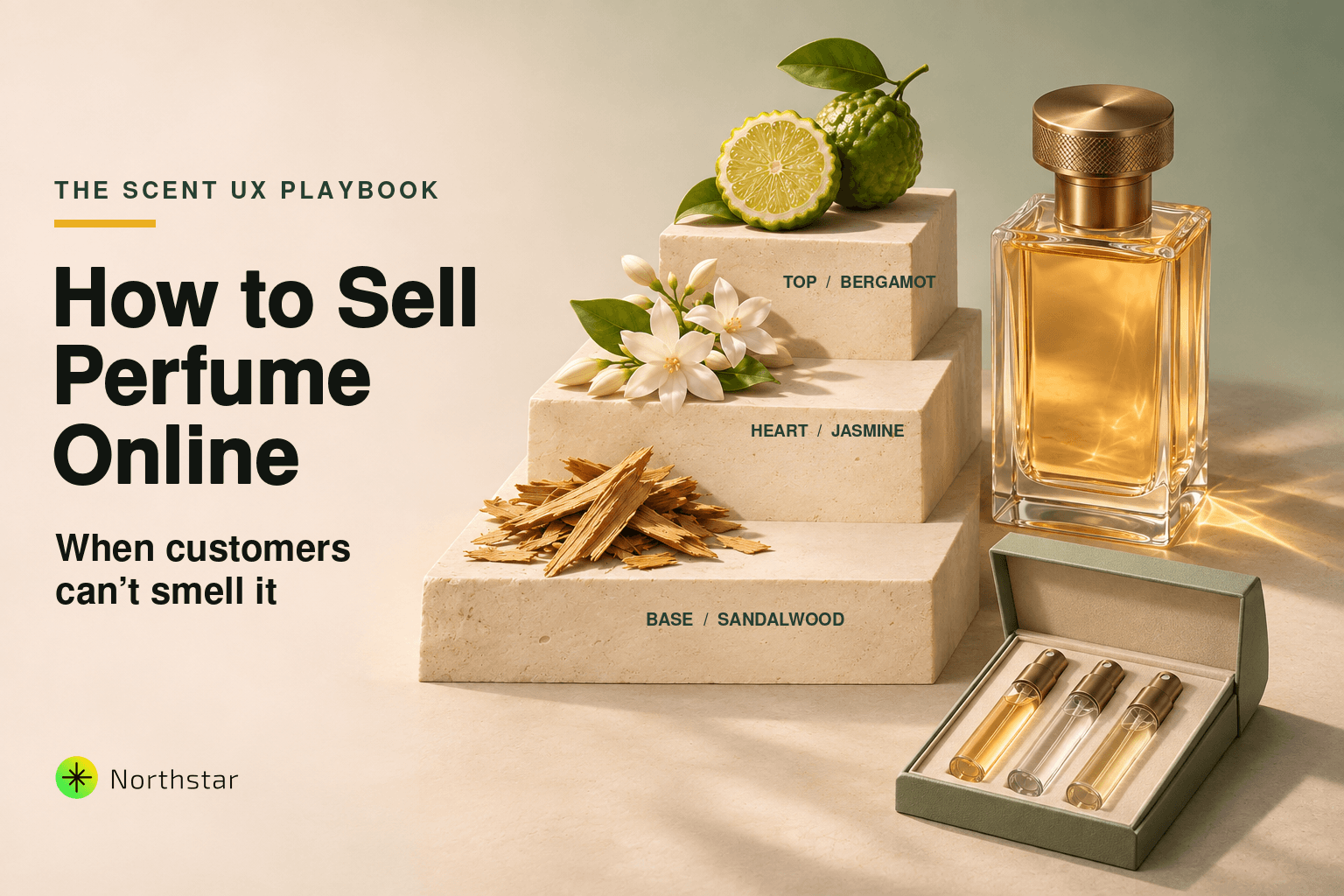
To build sensory imagination, leading fragrance stores use a visual fragrance note pyramid that breaks the olfactory architecture into three distinct stages:
| Pyramid Tier | Wear Duration | Sensory Role | Common Note Examples |
|---|---|---|---|
| Top Notes (Head) | First 15 – 30 minutes | The immediate initial burst; light, volatile molecules that create the first impression. | Italian Bergamot, Pink Pepper, Grapefruit, Cardamom |
| Heart Notes (Heart) | 2 – 4 hours | The core identity and personality of the fragrance that emerges as top notes settle. | Damask Rose, Jasmine Sambac, Lavender, Nutmeg |
| Base Notes (Dry-Down) | 6 – 12+ hours | The heavy, warm fixatives that anchor the scent to the skin and fabric until the end of the day. | Bourbon Vanilla, Ambergris, Creamy Sandalwood, Indonesian Oud |
By rendering these stages visually—paired with evocative botanical ingredient imagery—you trigger olfactory synesthesia: the customer's brain connects the visual of crisp Italian bergamot and warm amber resin to imagined scents they already know and love.
Pillar 2: Objective Performance Dials (Sillage, Longevity & Seasonality)
Beyond what a perfume smells like, online buyers have two critical practical questions before pulling out their credit card:
- How long will it last? (Longevity)
- Will people around me smell it, or will it give my coworkers a headache? (Sillage & Projection)
Instead of burying this in paragraph copy, high-converting perfume themes display standardized visual metric dials:
- Longevity Meter: Rated on a visual scale from Moderate (4–6 hours) to Long Lasting (8–10 hours) to Eternal (12+ hours).
- Sillage / Projection Scale: Clearly categorized as Intimate (arm's length), Moderate (leaves a subtle scent trail), or Enormous (room-filling presence).
- Occasion & Seasonality Tags: Badges indicating whether the scent is best for Date Night, Office Everyday, Summer Heat, or Winter Formal.
Providing objective performance metrics dismantles blind-buy anxiety and sets accurate customer expectations, cutting return requests and negative reviews by over 40%.
Pillar 3: The Interactive Scent Quiz (Eliminating Choice Paralysis)
When a shopper lands on a catalog featuring 25 different artisanal fragrances, decision fatigue sets in immediately. Without a sales associate behind a counter to ask "What kinds of scents do you usually wear?", most shoppers bounce within 45 seconds.
The digital equivalent of an in-store fragrance consultation is an interactive scent quiz & fragrance finder.
How a 4-Step Scent Quiz Converts:
- Step 1: Primary Scent Family: Do they lean toward Fresh & Aquatic, Warm Woods, Decadent Gourmand, or Sensual Ambers?
- Step 2: Intended Vibe & Occasion: Is this for daily signature wear, cozy fall evenings, or formal black-tie events?
- Step 3: Intensity Preference: Do they want an intimate skin scent or bold, compliments-pulling projection?
- Step 4: Personalized Recommendation + Instant Sample Add: The quiz delivers 1 primary signature recommendation and 2 complementary alternatives, with a 1-click button to add travel spray sizes directly to the cart.
Stores implementing native scent quizzes report a 3x increase in average session duration and a 28% higher conversion rate compared to standard static collection browsing.
Pillar 4: The Discovery Set Funnel (The $30 Gateway to $200 Bottles)
Here is the single most important secret of high-growth DTC fragrance brands: They never force a new customer to blind-buy a full $180 bottle upfront.
Instead, their entire top-of-funnel customer acquisition is built on a custom perfume discovery set builder combined with an automated voucher credit rebound:
The Discovery Set & Voucher Unit Economics:
- The Low-Friction Entry: Shoppers build a personalized sample box (e.g., choose 5 × 2ml mini atomizers for $30 to $35 with free shipping). The risk barrier is completely gone.
- The Full-Bottle Store Credit: Inside the custom sample box (and via automated post-purchase email), the customer receives a unique $30 voucher code redeemable toward any full-size 50ml or 100ml bottle within 30 days.
- The High-Margin Conversion: After wearing the five scents in real life over a week, 35% to 45% of discovery set purchasers return to buy a full bottle. Because the customer tests the fragrance on their skin, product satisfaction is near 100%, and product returns drop to virtually zero.
Native Liquid Theme vs. Third-Party App Bloat
When merchants try to assemble these features using standard Shopify themes (like Dawn or Prestige), they quickly run into technical debt:
- They install an Octane AI or Quiz app ($50–$200/mo).
- They install a custom Bundle Builder app for discovery sets ($30–$80/mo).
- They install custom metafield accordion apps for note pyramids ($15–$30/mo).
The result? 5+ extra JavaScript bundles loading on your storefront, pushing page load times past 4.5 seconds on mobile, and costing over $150 to $300 in recurring monthly app subscriptions.
This is why forward-thinking fragrance brands choose NorthStar Perfume Shop Shopify Theme (and its BigCommerce counterpart). Built specifically for modern perfumery, all four Scent UX pillars—discovery set builders, olfactory pyramids, scent quizzes, and longevity meters—are natively integrated into clean Online Store 2.0 Liquid code with zero external app dependencies and lightning-fast Core Web Vitals.
Frequently Asked Questions
How do you sell perfume online when customers cannot smell it?
To sell perfume online successfully, you must translate olfactory senses into visual and experiential cues: (1) Display interactive fragrance note pyramids (Top, Heart, Base), (2) provide clear sillage and longevity rating dials, (3) guide shoppers with an interactive scent quiz, and (4) offer risk-free sample discovery sets with store credit toward full bottles.
What is the "Discovery Set Voucher" model in fragrance ecommerce?
The Discovery Set model allows customers to purchase a custom sample pack (e.g., 5 × 2ml vials for $30) that includes an enclosed $30 coupon code toward any full 50ml or 100ml bottle. This completely eliminates blind-buy anxiety and drives a 35% to 45% conversion rate into full-size bottle purchases.
What is the difference between Top, Heart, and Base fragrance notes on a product page?
Top notes are volatile opening scents detected immediately (lasting 15–30 minutes, like citrus or herbs). Heart (middle) notes form the main personality of the perfume as top notes fade (lasting 2–4 hours, like florals or spices). Base notes are heavy, fixative ingredients (like amber, vanilla, or oud) that linger for 6–12+ hours and form the lingering dry-down.
Do I need expensive third-party apps to add scent quizzes and discovery sets to Shopify?
No. Stacking multiple third-party Shopify apps for quizzes, custom bundles, and metafields adds $100+/month in recurring fees and causes severe script lag. With a purpose-built theme like NorthStar Perfume Shop Theme, discovery set builders, scent note pyramids, and interactive quizzes are built directly into the Liquid codebase with zero app fees.
How does sillage and longevity information improve perfume conversion rates?
Perfume shoppers want to know how far a scent projects and how long it lasts on skin. Providing standardized, visual meters for Sillage (Intimate, Moderate, Strong) and Longevity (4h, 8h, 12h+) answers their most critical purchasing objection and drastically reduces product returns.
Ready to transform your fragrance brand into a high-converting digital experience? Explore how NorthStar's Perfume Shop Shopify Theme and BigCommerce Perfume Theme give you the exact Scent UX tools needed to turn curious visitors into passionate fragrance collectors.