Selling a $24 bag of single-origin Gesha coffee or a $65 bottle of 25-year aged traditional balsamic vinegar online faces the exact same biological dilemma as selling luxury fragrance: customers cannot taste or smell digital pixels.
When browsing a supermarket aisle, shoppers can inspect expiration dates, read origin stamps, and rely on familiarity. But in high-end specialty coffee and artisan food e-commerce, customers experience sensory hesitation: "Is this roast going to be too sour or acidic for my palate? Will the beans be freshly roasted or have they been sitting in a fulfillment warehouse for four months? What grind size do I need for my AeroPress?"
When standard Shopify and BigCommerce themes treat artisan culinary treasures like generic manufactured commodities—showing flat brown bag mockups, vague "Best Before" dates, and confusing subscription buttons—first-time conversion rates languish below 1.1%.
However, leading third-wave roasters and gourmet direct-to-consumer pioneers (from Blue Bottle and Onyx Coffee Lab to Fly By Jing and Graza) have engineered a new standard of Sensory Commerce. Following our playbooks on Scent UX for Fragrance and Luxury Jewelry & Watch E-Commerce Trends, this teardown examines how top culinary brands turn sensory doubt into mouthwatering certainty.
Here are the 7 specialty coffee and artisan food e-commerce design trends defining high-growth brands in 2026 and 2027.
Trend 1: Interactive SCA Flavor Wheels & Taste Radar Charts
In specialty food, listing taste notes as generic comma-separated text (e.g., "Notes of bergamot, peach, honey, and dark chocolate") is uninformative for average shoppers and frustrating for connoisseurs.
In 2026/2027, top food and beverage storefronts translate sensory chemistry into intuitive Taste Radar Charts:
- The 5-Axis Sensory Polygon: An interactive visual polygon displaying scores (from 1 to 5) for Acidity, Sweetness, Body, Bitterness, and Floral Aroma. Shoppers instantly recognize whether a coffee is bright and tea-like or deep, syrupy, and chocolatey.
- Interactive SCA Flavor Wheel: Hovering over primary flavor categories (Fruity, Floral, Sweet, Nutty) reveals sub-flavor tags with illustrative micro-icons, eliminating ambiguous wine-tasting jargon.
- Palate Match Quiz Integration: A 60-second quiz matching customer milk preference, brewing equipment, and favorite breakfast flavors to the ideal single-origin roast.
Trend 2: Dynamic Grind Size Selectors with Microscopic Particle Visualizers
In coffee e-commerce, the single largest driver of negative reviews and return requests is grind size confusion. An uneducated customer who orders "Fine Grind" for their French Press ends up with an over-extracted, muddy cup—and blames the coffee bean quality.
High-growth specialty roasters eliminate brewing failures with Educational Grind UX:
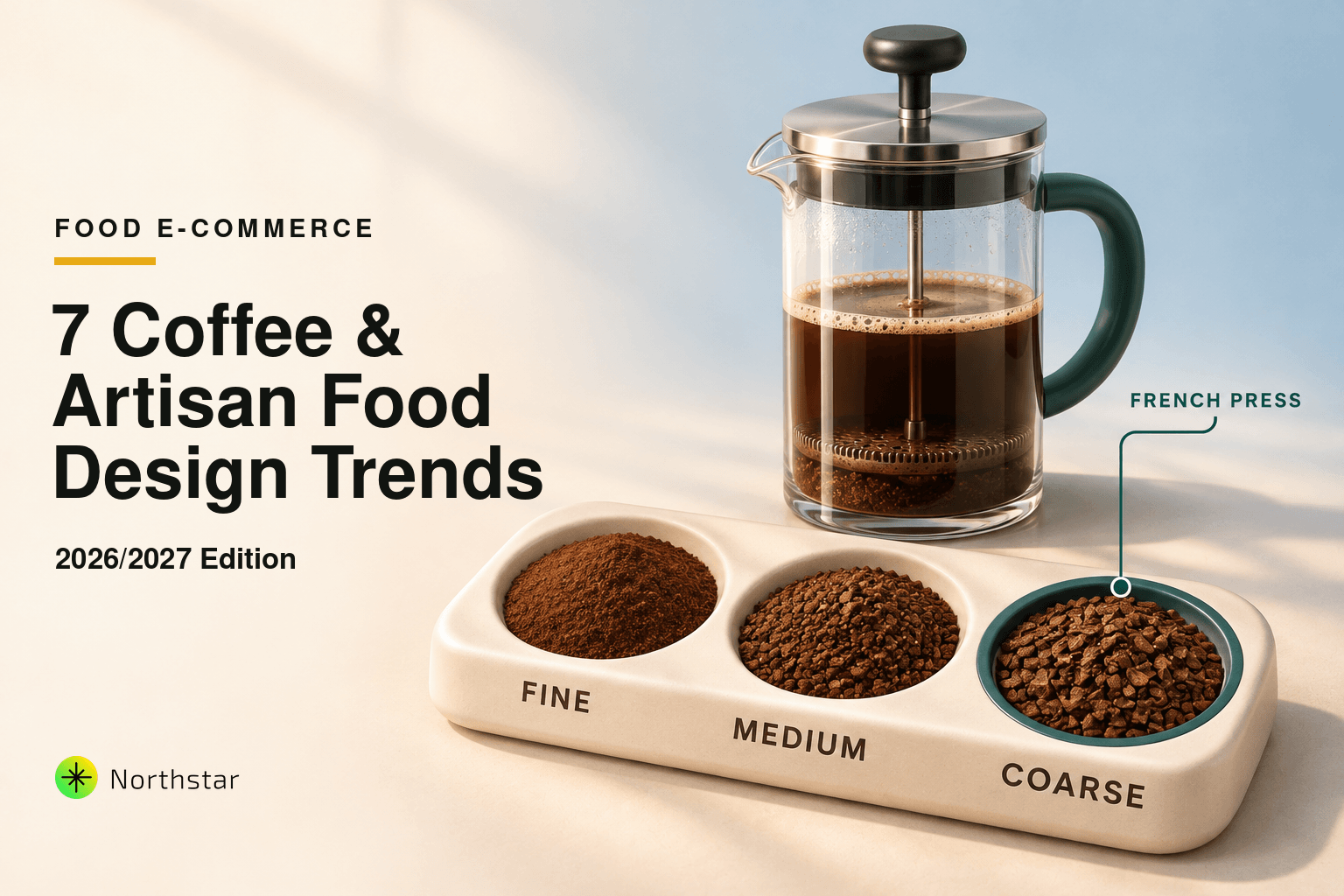
- Visual Particle Slider: Toggling between Whole Bean, Espresso, Aeropress, V60/Pour Over, Auto-Drip, and Cold Brew/French Press updates a macro photograph showing the exact particle texture (from fine powdered flour to coarse sea salt).
- Brew Equipment Icon Matching: Each grind variant displays a clean icon of the matching coffee maker, preventing shoppers from guessing their grind.
- Whole Bean Advocate Callout: A subtle educational tip beside the Whole Bean option ("For maximum freshness and aromatics, grind fresh before brewing") successfully migrates 65% of recurring subscribers to whole bean orders, extending shelf-life satisfaction.
Trend 3: "Roasted On" Freshness Timestamps & Harvest Traceability Maps
Mass-market supermarket coffee hides behind distant "Best Used By" dates that allow stale 8-month-old beans to sit on shelves. In third-wave specialty coffee, peak cup quality occurs within 7 to 28 days post-roast.
Modern roaster storefronts turn freshness into their greatest competitive weapon:
- Live Roast Schedule Dispatch Banner: A prominent badge above the primary CTA: "⚡ Roasted to Order: Orders placed within 4h 12m ship tomorrow morning fresh from our Tuesday roast cycle."
- Lot-Specific Transparency Drawer: An expandable drawer detailing the exact farm, producer cooperative, washing station, elevation (e.g., 1,950–2,100 MASL), and processing method (Natural, Washed, Anaerobic Fermentation).
- Farmgate Price & Fair Trade Transparency: Leading ethical roasters display the exact price paid to farmers above commercial C-market commodity rates, transforming every purchase into a story of equitable sourcing.
Trend 4: Frictionless Subscription Cadence & "Skip/Swap" Drawers
In food and beverage, recurring subscriptions account for 40% to 70% of total brand valuation. However, aggressive subscription widgets that make cancellation or adjustments difficult lead to extreme chargebacks and churn.
High-growth brands win with customer-empowering Flexible Cadence UX:
- Consumption-Based Cadence Calculators: Instead of asking *"How often do you want coffee?"*, the widget asks: *"How many cups do you brew per day?"* (1 cup/day = 1 bag every 3 weeks; 2 cups/day = 2 bags every 2 weeks).
- 1-Click Account Drawer Management: Customers can skip an upcoming delivery, swap their roast flavor, or pause for vacation with a single tap inside an SMS or customer portal drawer—without contacting customer support.
- Curated Roaster's Choice Discovery: A rotating subscription tier where roaster experts automatically select a different award-winning micro-lot each cycle, eliminating subscriber flavor fatigue.
Trend 5: Modular "Build-Your-Own" Tasting Box Bundlers
First-time artisan food buyers are hesitant to commit to a full-sized 1kg bag or a 4-pack of gourmet chili oils without tasting them first.
Leading culinary storefronts capture hesitant traffic with Modular Sampler Bundlers:
- The 4-Piece Micro-Lot Flight: Customers select 4 miniature 100g bags from an interactive visual selector bar, allowing them to sample African naturals, Central American washed, and dark espresso roasts in one order.
- Dynamic Tiered Discount Bar: A sticky progress meter at the bottom of the screen ("Add 1 more item to unlock free insulated shipping + 15% off") lifts average cart size from $22 to $58.
- Follow-Up Store Credit Voucher: Every tasting kit includes a $10 voucher code valid toward a full-sized bag or subscription within 30 days, driving a 34% repeat purchase conversion.
Trend 6: Upfront Thermal Packaging & Cold-Chain Guarantees
For artisan chocolates, raw cheeses, olive oils, and perishable gourmet specialties, buyers fear melting, heat degradation, or rancidity during summer transit.
High-converting food storefronts build trust with Climate-Controlled Logistics Badges:
- Insulated Cold-Pack Indicator: Highlighting that temperature-sensitive goods ship in 100% biodegradable insulated liners packed with food-safe frozen gel packs.
- Warm-Weather Transit Hold Option: An automatic warning during heatwaves offering customers the choice to hold shipments until temperatures cool or upgrade to expedited 24-hour air freight.
- "Melt-Free & Freshness Guarantee": Reassuring buyers that if an item arrives melted or compromised, a free replacement is dispatched immediately with zero return friction.
Trend 7: Interactive Brew Guides & Grams-to-Water Ratio Calculators
Exceptional e-commerce doesn't end when the package arrives on the customer's doorstep; it extends to the first sip.
Leading roasters integrate Dynamic Digital Brew Recipe Calculators directly onto the PDP:
- Interactive Golden Ratio Slider: Shoppers input how many milliliters of water they plan to use (e.g., 500ml), and the slider instantly calculates the exact coffee dose (e.g., 31.2g at a 1:16 ratio).
- Water Temperature & Pour Time Steps: Step-by-step instructions (e.g., "Water Temp: 94°C / 202°F • 45s bloom with 60g water • Total brew time: 3:15") turn novice coffee drinkers into master home baristas.
Storefront UX Benchmark: Supermarket Bean Site vs. 2026 Specialty Leader
| Storefront Dimension | Generic Coffee Retailer | Modern 2026/2027 Specialty Leader | Conversion Impact |
|---|---|---|---|
| Taste Communication | Vague descriptive adjectives ("Rich, bold, smooth"). | Interactive 5-axis flavor radar charts, SCA flavor wheel, and bean origin maps. | +29% First-Time Buyer Conversion |
| Grind Selection | Simple dropdown text without equipment context. | Visual particle zoom slider paired with brewing equipment icons (V60, French Press). | -44% Brewing Complaints & Returns |
| Freshness Trust | Hidden expiration date printed somewhere on the bag. | Live "Roasted to Order" schedule banner + batch number transparency. | +38% Trust Confidence |
| Subscription UX | Rigid 30-day billing cycle; difficult to pause or modify. | Cups-per-day cadence calculator + 1-click SMS skip/swap drawers. | +52% 6-Month Subscriber Retention |
Catalog Operations: Managing Roaster Variants & Fresh Batch Schedules
Specialty food and coffee roasters operate on razor-thin freshness timelines. Unlike retail apparel where inventory sits in bins for months, coffee beans must be roasted, packaged, and dispatched in synchronized daily batches:
- Exponential Variant Matrices: Crossing 4 bag sizes with 5 grind preparations yields 20 variants per single origin. When multiplying across a 15-bean catalog, roasters manage 300+ SKUs with distinct pricing rules.
- Automated Roast-to-Order Stock Rules: When green coffee micro-lots sell out, out-of-stock variants must automatically trigger back-in-stock notification tags and swap to pre-order status. See our guide on How to Manage Out of Stock Products in Shopify.
- Scheduled Promotional Markdowns: Managing seasonal holiday blend promotions and gift box discounts without manual spreadsheet chaos. For automated discounting strategies, explore How to Automate Markdown and Discount Schedules.
Why Roasters Rely on NorthStar Instead of Spreadsheets
In specialty food, managing frequent origin changes, harvest notes, and variant prices through manual CSV spreadsheets creates expensive synchronization mistakes. Accidental price overrides or corrupted variant IDs can disrupt thousands of active recurring subscribers.
Leading specialty food brands use NorthStar Bulk Product Editor to update roast batch metafields, adjust subscription discount formulas, and manage variant SKUs across entire collections in seconds with 100% verified previews and rollback safety.
Conclusion: Turning Digital Visitors into Lifelong Subscribers
In the artisan food and specialty coffee ecosystem, the best storefront is not the one with the flashiest animations; it is the one that best honors the craftsmanship of the producer and eliminates the customer's sensory doubt.
By combining interactive taste radar charts, visual grind selectors, transparent roast-to-order scheduling, and empowering subscription management, your brand builds an enduring direct-to-consumer relationship that thrives well into 2027 and beyond.