Selling a $650 double-breasted cashmere trench coat or a $380 pair of handcrafted Italian leather Chelsea boots online is an exercise in managing customer anxiety.
When customers shop for apparel online, they cannot touch the fabric weight, test the shoulder seam drape, or try on two adjacent sizes in a fitting room. This sensory vacuum creates immense hesitation: "Does this brand run small in the shoulders? Will this silk blend cling unflatteringly to my hips? How does this camel tone look in natural daylight versus warm studio lighting?"
When brands fail to answer these questions, customers either abandon their carts or adopt "bracketing" behavior—ordering sizes Small, Medium, and Large with the explicit intention of returning two (or all three). The result is devastating: apparel e-commerce suffers an average 30% to 40% return rate, destroying gross margins and creating an operational nightmare of return shipping, dry cleaning, and inventory depreciation.
Following our breakdowns for Luxury Jewelry & Watches and Scent UX for Fragrance, this guide reveals how high-growth fashion houses turn fit hesitation into high-converting confidence.
Here are the 7 luxury fashion and apparel e-commerce design trends defining high-growth brands in 2026 and 2027.
Trend 1: True-to-Size Community Fit Heatmaps
For decades, apparel stores relied on static "Size Charts" featuring generic bust, waist, and hip centimeters. In practice, shoppers rarely carry tape measures, and garment geometry varies wildly based on silhouette (oversized vs. tailored).
In 2026/2027, high-growth fashion storefronts replace abstract tables with Empirical Fit Consensus Heatmaps:
- The 5-Point Consensus Bar: A visual spectrum displaying: Runs Small (8%) • Slightly Snug (12%) • True to Size (74%) • Slightly Loose (5%) • Runs Large (1%) based on verified buyer data.
- Anatomical Micro-Ratings: Expandable ratings detailing specific fit zones: *"Shoulders: Tailored • Torso: Relaxed • Sleeve Length: Long"*.
- Shopper Body Metric Filters: Customers can filter reviews by height, weight, and typical brand size (e.g., *"Show me reviews from women who are 5'7", 140 lbs, who wear Size US 6"*).
Trend 2: 3D Fabric Physics & Motion Drape Video
A still photograph is fundamentally incapable of communicating fabric hand-feel and weight. A cheap synthetic polyester blend can look identical to a 16-momme mulberry silk dress when airbrushed in Photoshop.
Leading fashion houses build trust by demonstrating Fabric Motion in Real Time:
- Continuous 4-Second Motion Loops: As the user hovers over a product card or scrolls the PDP gallery, a fluid video shows the model walking, pivoting, and sitting down. Shoppers instantly observe how the fabric breaks, creases, and flows under natural movement.
- Macro Fabric Weave Loupe: An interactive 10x magnification zoom showcasing the intricate twill weave, raw slub texture of selvedge denim, or hand-stitched pick-stitching on lapels.
- Fabric Grams-per-Square-Meter (GSM) Transparency: Educating discerning buyers on material heft (e.g., *"Heavyweight 450 GSM French Terry Cotton vs. Lightweight 180 GSM Jersey"*).
Trend 3: "Shop the Look" Interactive Ensemble Drawers
High-end luxury brands invest hundreds of thousands of dollars in editorial lookbooks, styling models with complete coordinated outfits. Yet, on standard e-commerce stores, customers have to hunt across 4 different categories to find the belt, trousers, and bag shown in the photo.
Modern 2026 storefronts turn editorial photography into Frictionless Outfit Bundlers:
- The Slide-Out Look Drawer: Clicking an elegant "Shop This Entire Look" button on the PDP opens a curated drawer containing every styled item.
- Integrated Variant Pickers: Shoppers select their size for each item directly inside the drawer without navigating away from the primary product page.
- Tiered Ensemble Discounting: A subtle incentive (e.g., *"Complete the full 3-piece look and receive a complimentary $75 garment care kit"*), driving average order values past $800.
Trend 4: Multi-Model Body Diversity & Height Toggles
Nothing alienates a customer faster than seeing every single garment modeled exclusively on a 5'11" US Size 0 runway model. A customer who wears US Size 10 cannot accurately visualize where hemlines will fall or how proportions translate.
Progressive apparel brands solve visual bias with Dynamic Model Switchers:
- Instant Model Switcher: A clean toggle on the gallery allowing shoppers to view the exact same dress or coat modeled by Model A (5'10", Size US 2), Model B (5'7", Size US 8), or Model C (5'5", Size US 14).
- Hemline Reference Markers: Clear anatomical annotations indicating where the hem falls relative to average heights (e.g., *"Hits mid-calf on heights 5'4"–5'7""*).
Trend 5: Tactile Swatch Sampling & Unboxing Transparency
For luxury eveningwear, bespoke suiting, and high-ticket cashmere, ordering without touching the textile represents extreme friction.
Following the successful model we detailed in Furniture Design Trends, fashion brands are embracing Material Swatch Kits:
- Fabric Sample Booklets: Shoppers can order a curated swatch kit containing 2x2 inch swatches of raw silks, leathers, and wools for $15, accompanied by an immediate $30 credit toward their full garment purchase.
- Garment Presentation Guarantees: Visualizing the delivery packaging—including museum-grade breathable canvas garment bags, cedar coat hangers, and embossed gift boxes.
Trend 6: VIP Drop Timers & Early-Access Reservation Architecture
Modern luxury and streetwear fashion thrives on scarcity, exclusivity, and community anticipation.
High-converting storefronts replace chaotic product launches with Engineered Drop UX:
- Tier-Gated Early Access: VIP loyalty members unlock early access 2 hours prior to public release via magic-link SMS authentication.
- Dynamic Anti-Bot Cart Locks: When a user reserves a high-demand piece in their cart, an interactive 10-minute timer holds the inventory, eliminating checkout panic and preventing reseller bot scalping.
Trend 7: White-Glove Concierge Tailoring & Pre-Hemmed Options
In luxury retail, standard off-the-rack sizing rarely fits every customer perfectly. For tailored trousers and overcoats, having to visit a local tailor after receiving an expensive order adds unwanted effort.
Top brands differentiate by offering Complimentary Pre-Hemming UX:
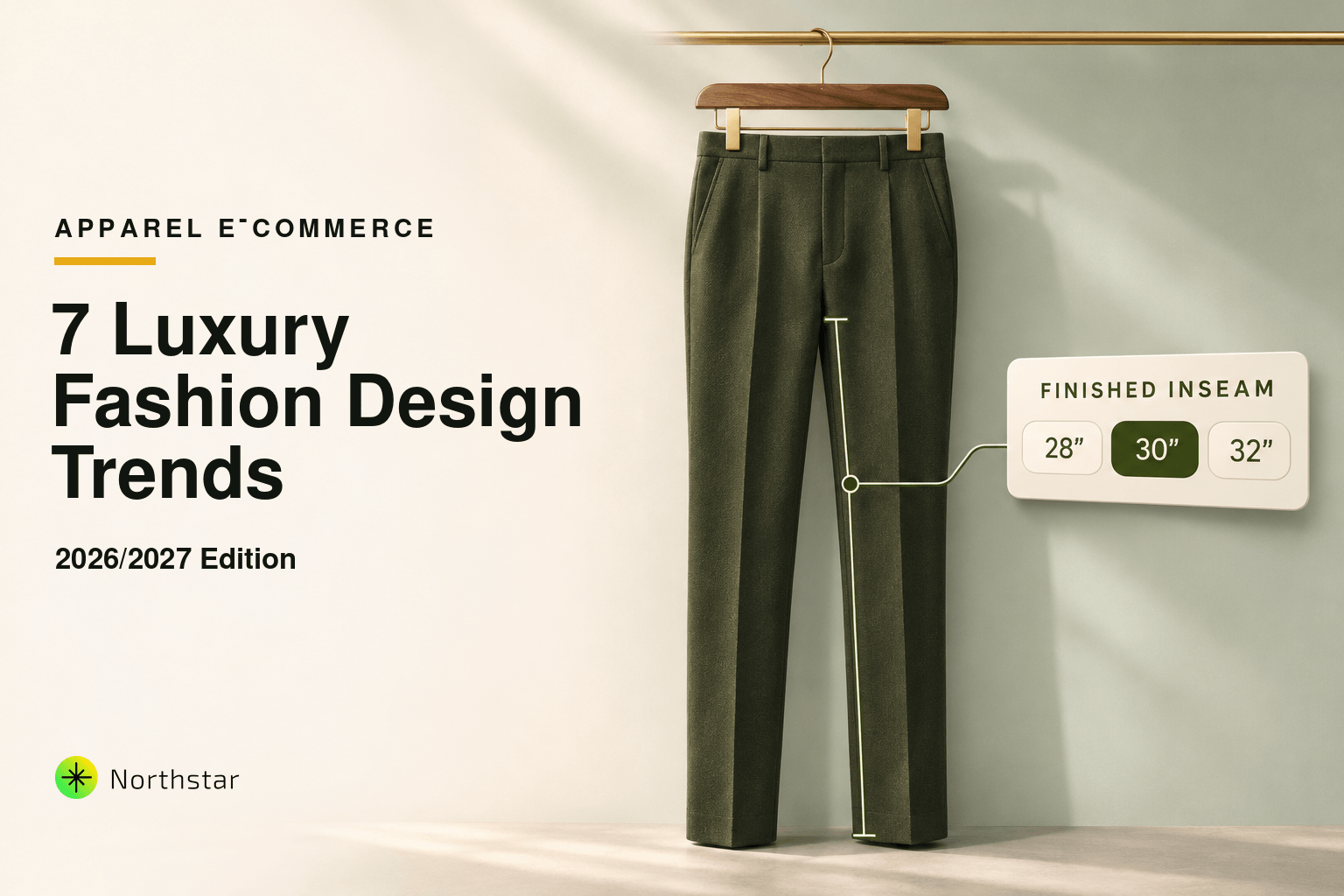
- Custom Inseam Selector: Shoppers can select an exact finished inseam (e.g., 28", 30", 32", 34") directly on the product detail page.
- Cuffed vs. Clean Hem Finishing: Allowing the customer to choose their preferred cuff style with a live visual preview.
Storefront UX Benchmark: Fast Fashion vs. 2026 Luxury Leader
| Storefront Dimension | Fast Fashion Retailer | Modern 2026/2027 Luxury Leader | Impact on Profitability |
|---|---|---|---|
| Fit & Sizing | Generic static size chart; zero customer feedback context. | True-to-Size consensus heatmaps + multi-model height toggles. | -34% Fit-Related Return Requests |
| Fabric Communication | Airbrushed static packshots; fabric looks stiff or artificial. | 4-second motion drape loops + 10x weave loupe + GSM weight specs. | +28% High-Ticket Cart Conversion |
| Styling & Upselling | Generic "You May Also Like" recommendation carousels. | Slide-out "Shop the Look" outfit drawers with 1-click variant pickers. | +31% Cross-Sell AOV Lift |
| Unboxing Experience | Garment shipped in cheap plastic polybag. | Branded canvas garment bags, wooden hangers, and insured delivery. | +42% Lifetime Brand Loyalty |
Catalog Operations: Managing Complex Multi-Dimensional Matrices
Behind a refined fashion storefront lies one of the most variant-intensive catalog environments in digital retail:
- Multi-Dimensional Matrix Variants: Crossing 6 sizes (XS–XXL) with 4 seasonal colors and 3 inseams creates 72 individual SKUs per garment. For strategies on standardizing variant codes, see our guide on Bulk Editing Product Variants and SKUs in Shopify.
- End-of-Season Markdown Scheduling: Transitioning fall/winter collections to archive sales requires automated percentage discounts and promotional compare-at pricing. Learn more in our tutorial on How to Schedule Sales and Revert Prices Automatically.
- Accurate Barcodes and Inventory Sync: Ensuring every size/color barcode matches warehouse fulfillment systems. See our walkthrough on Bulk Updating Barcodes and GTINs in Shopify.
Why Fashion Brands Avoid CSV Spreadsheet Chaos
In fashion commerce, one misaligned column in a 10,000-row CSV file can accidentally zero out prices, swap size tags, or erase high-resolution lifestyle images. Furthermore, Shopify's standard CSV import offers no visual preview and no atomic rollback.
Leading apparel brands manage their catalogs with NorthStar Bulk Product Editor. With NorthStar, fashion merchandising teams can filter by collection or season, mass-tag products, update variant prices, and audit every change with live before-and-after diffs.
Conclusion: Transforming Fitting Room Uncertainty into Digital Elegance
Luxury fashion e-commerce is no longer about simply displaying pretty clothing on a white screen; it is about building an empathetic digital salon that anticipates customer fit hesitations before they occur.
By investing in True-to-Size heatmaps, motion drape video, modular outfit drawers, and multi-model diversity, your storefront eliminates return friction and delivers the bespoke luxury experience that modern fashion connoisseurs demand.