Persuading an online shopper to spend $4,500 on a diamond engagement ring or $12,000 on a Swiss chronometer is one of the steepest psychological hurdles in modern digital commerce.
When customers buy apparel or home goods, the emotional stakes and financial downside of a mistake are manageable. But in fine jewelry and luxury horology, online shoppers face four paralyzing fears:
- Counterfeit & Authenticity Anxiety: "Is this diamond truly eye-clean and certified by GIA, or is this an unaccredited knockoff?"
- Scale & Fit Blindness: "Will a 41mm watch case overhang my 6.5-inch wrist? What if this engagement ring band is the wrong finger size?"
- Optical Fire & Craftsmanship Deficit: "Will this sapphire dial catch the light naturally, or does the product only look good in doctored studio renders?"
- Logistical Terror: "Will an insured $10,000 courier package be left unattended on my front porch?"
When standard Shopify stores treat high-value heirloom pieces like $35 fashion bracelets—relying on static white-box packshots, unformatted spec tables, and generic shipping checkboxes—conversions plummet to 0.3%–0.6%.
However, leading luxury houses and high-growth DTC disruptors (from Mejuri and Brilliant Earth to Hodinkee and Bucherer) are reinventing the digital salon. Just as we analyzed in our breakdowns of Scent UX Playbooks for Luxury Perfume and Furniture E-Commerce Spatial UX, luxury jewelry and watch brands succeed by converting sensory doubt into digital certainty.
Below, we examine the 7 luxury jewelry and watch e-commerce design trends defining high-growth brands in 2026 and 2027.
Trend 1: 4K Scintillation Loops & 360° Movement Spinners
In fine jewelry and mechanical watchmaking, static photography is fundamentally incapable of communicating product value.
A diamond's true beauty comes from optical performance: brilliance (white light reflection), fire (spectral dispersion colors), and scintillation (the sparkle pattern produced when the light source or stone moves). Similarly, the finishing of a Swiss mechanical movement—such as hand-applied Côtes de Genève stripes, perlage on the mainplate, and polished chamfered bevels—only reveals itself as ambient light shifts across the caliber.
In 2026/2027, high-growth storefronts have replaced static packshots with interactive 4K Scintillation Micro-Loops:
- Standardized Optical Lighting: Stones are captured under calibrated 5500K daylight-balanced illumination with controlled spotlighting to reveal authentic facet symmetry and light return.
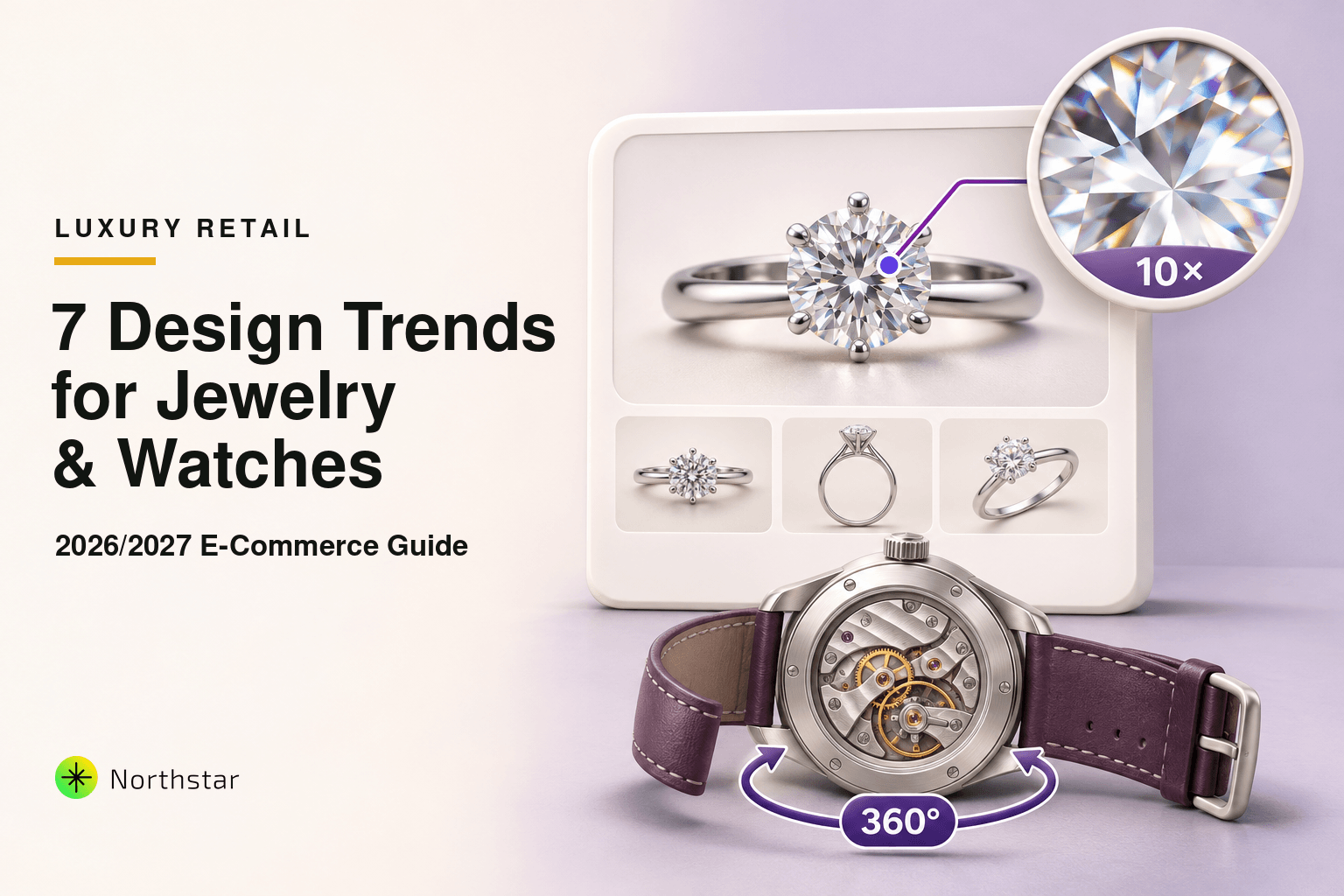
- Micro-Inclusion Transparency (10x Loupe View): High-intent diamond buyers want to inspect clarity characteristics. Providing smooth 10x and 20x interactive zoom directly in the media gallery builds radical trust by proving inclusions are 100% eye-clean.
- Exhibition Caseback 360° Spinners: For luxury timepieces, horology buyers spend up to 40% of their PDP session time inspecting the open sapphire caseback. Interactive spinners allow collectors to drag and rotate the movement, watching the balance wheel oscillate and the winding rotor swing.
Trend 2: The GIA / IGI Digital Certificate Vault & 4Cs Radar
Historically, e-commerce stores handled diamond grading by burying a hyperlinked text snippet like "Includes GIA Certificate (PDF)" at the bottom of a specifications tab. Clicking it opened a generic, unstyled scan of a paper certificate that looked like a legal subpoena.
In 2026, progressive brands transform diamond documentation from a bureaucratic document into a centerpiece trust experience:
- In-Modal Certificate Vault: Shoppers click an interactive "View Verified GIA Certificate" badge on the PDP. A sleek glassmorphic drawer slides open, displaying real-time digital verification queried directly from the GIA or IGI laboratory API.
- Visual 4Cs Breakdown: Instead of raw letters and acronyms ("VS1, F, Triple Excellent"), the vault renders intuitive visual scales comparing Cut, Color, Clarity, and Carat against industry benchmarks.
- Interactive Plotting Diagram: Buyers can toggle a digital plotting diagram that highlights pinpoints, clouds, or feather inclusions alongside an explanation of why the stone achieved its high grading score.
- Laser Inscription Verification: The modal showcases a high-magnification photograph of the diamond's girdle showing the micro-laser inscribed certificate serial number matching the official grading dossier.
Trend 3: Interactive Carat & Multi-Metal Visualizers Across Diverse Skin Tones
One of the primary causes of jewelry cart abandonment is color-and-scale uncertainty: "How will 18K yellow gold look against my pale undertones? Is 1.5 carats too subtle or too overpowering on a petite hand?"
High-growth jewelry storefronts solve this by moving away from isolated CAD computer renders in favor of interactive live-swatch visualizers:
- Instant Metal Swapping: Shoppers toggle seamlessly between Platinum, 18K Yellow Gold, 18K White Gold, and 18K Rose Gold. The media gallery swaps lighting-consistent photos showing realistic metallic reflections and prong settings in under 100 milliseconds.
- Calibrated Skin Tone Switcher: Using a discrete spectrum selector (spanning Fitzpatrick skin phototypes I through VI), customers can view the ring or necklace against a hand model that closely matches their personal complexion.
- Carat Slider on Hand: An interactive slider lets shoppers compare 1.0ct, 1.5ct, 2.0ct, and 3.0ct diamond proportions side-by-side on a calibrated finger, eliminating size second-guessing before checkout.
Trend 4: Proportional Wrist-to-Case & Lug-to-Lug Visualizers
In luxury watch e-commerce, the single most searched query after price is: "Is this watch too big for my wrist?"
Traditional spec tables provide the case diameter (e.g., 42mm), but case diameter alone is notoriously misleading. A 42mm watch with short, curved lugs can wear smaller than a 39mm watch with long, flat lugs. If the watch overhangs the buyer's wrist, the return is guaranteed—and in horology, handling high-value returns incurs immense insurance and inspection costs.
The modern 2026 horology storefront addresses this with Proportional Wrist UX:
- Wrist Circumference Slider: Shoppers select their wrist size (from 6.0" / 15cm up to 8.0" / 20cm). The interactive canvas renders the watch case directly onto a scaled wrist, clearly showing whether the lugs remain within the wrist contour.
- Lug-to-Lug and Thickness Schematics: Top stores provide clear blueprint diagrams showing the critical three dimensions: Case Diameter, Lug-to-Lug span, and Total Case Thickness (including domed sapphire crystal).
- Cuff & Sleeve Profile Comparison: An interactive slider demonstrates how smoothly the timepiece slides under a tailored dress shirt cuff versus a casual jacket sleeve.
Trend 5: Frictionless Ring Sizing UX & At-Home Try-On Funnels
Ring sizing hesitation is the #1 friction point in bridal and fine jewelry e-commerce. Over 28% of rings purchased online without sizing assistance require post-purchase resizing, causing customer stress, delayed proposals, and high operational servicing expenses.
High-converting jewelry brands engineer a proactive, multi-tier sizing funnel directly on the PDP:
- Printable & Interactive Screen Sizers: A 1:1 printable credit-card-calibrated ring sizer sheet that allows shoppers to measure an existing ring's inner diameter in seconds.
- The Complimentary Ring Sizer Kit: An eye-catching button ("Don't Know Your Size? Request a Free Ring Sizer") sends a branded physical multi-sizer belt via express mail. When the customer completes their ring order, they receive an immediate complimentary sizing credit.
- Prominent "60-Day Complimentary Resizing" Guarantee: Placing a prominent security badge directly above the "Add to Bag" button reassuring the buyer that if the ring does not fit perfectly, the brand handles free insured return shipping and professional resizing.
Trend 6: Seamless Concierge Video Consultations & Virtual Showrooms
High-ticket luxury purchases are rarely 100% self-serve. At the $3,000 to $25,000 price point, shoppers desire the expertise, validation, and intimacy of a traditional Mayfair or 5th Avenue boutique salon.
Rather than hiding customer support behind an impersonal email ticket form or a generic automated chatbot, modern luxury storefronts integrate 1-Click Concierge Video Scheduling:
- PDP-Embedded Booking: A refined glassmorphic banner beneath the primary CTA: "Schedule a Private 15-Minute Consultation with a GIA Gemologist."
- High-Magnification Live Demonstration: During the video session, the specialist shares their screen and places multiple loose stones or finished rings under an HD gemological microscope, comparing cut parameters and setting styles in real time.
- Personalized Curated Cart Delivery: Following the consultation, the specialist sends an encrypted, customized checkout link pre-loaded with the exact certified stone and customized band discussed.
Trend 7: Armored Logistics, Discreet Packaging & Signature Delivery Transparency
The final barrier to completing a $10,000 transaction online is logistical panic: "Will this ring box sit in the rain? Will a delivery driver steal it? Will family members see the company branding and spoil the engagement surprise?"
High-growth luxury storefronts eliminate this hesitation by transforming shipping details from an afterthought into a primary trust pillar:
- Discreet Outer Box Guarantee: Explicitly reassuring the buyer that the shipping container is 100% unbranded, durable, and tamper-evident, ensuring complete surprise and security.
- Armored Courier Partnerships: Highlighting partnerships with specialized high-value carriers (such as Malca-Amit, Ferrari Express, or Brink's) for shipments exceeding $10,000, complete with armored vehicle transport and direct hand-to-hand signature delivery.
- 100% Comprehensive In-Transit Insurance: Displaying clear insurance badges confirming that every dollar of the timepiece or jewelry piece is fully covered until the recipient signs for receipt.
- Hold at Secure Carrier Location: Giving buyers the option to route high-value shipments to a secure local FedEx Ship Center or armored pickup vault rather than a residential doorstep.
Storefront UX Benchmark: Traditional Luxury vs. High-Growth 2026/2027
| Storefront Dimension | Traditional Luxury Retailer | Modern 2026/2027 High-Growth Storefront | Conversion Impact |
|---|---|---|---|
| Visual Media | Static white-background packshots; no facet movement. | 4K 60fps Scintillation loops, 10x loupe zoom, and 360° exhibition caseback spinners. | +28% to +34% Engagement & PDP Time |
| Certification & Trust | Scanned PDF link buried inside an accordion tab. | Interactive GIA/IGI Digital Vault with 4Cs visual radar & laser inscription lookup. | +42% Trust Confidence & Add-to-Cart Lift |
| Sizing & Scale | Generic text chart ("Ring sizes 4–10 available"). | Interactive finger carat slider, calibrated wrist-to-case visualizer, and free home sizer kits. | -38% Sizing Return Rates |
| Sales Assistance | Generic contact form or static FAQ page. | Embedded 1-click video consultations with certified gemologists & live microscope views. | +65% Closing Rate on Consultations |
| Delivery Experience | Standard shipping lines at checkout with surprise fees. | Armored courier badges, discreet packaging guarantees, and insured transit transparency. | -22% Final Step Checkout Abandonment |
The Catalog Architecture Behind Luxury E-Commerce Operations
Creating a frictionless luxury storefront is only half the battle. Behind the sleek glassmorphic UI lies an exceptionally complex catalog architecture:
- Precious Metal Spot Price Volatility: When gold surges from $2,400 to $2,750 per ounce, fine jewelry margins can be decimated overnight unless thousands of 14K, 18K, and Platinum ring variants are updated immediately.
- Unique Serialized Inventory & Metafields: Unlike commodity goods with generic barcodes, certified diamonds and numbered luxury timepieces possess unique GIA report numbers, laser inscriptions, and serial numbers that must be tracked per item. For a comprehensive walkthrough on barcode architecture, see our guide on Bulk Updating Barcodes and GTINs in Shopify.
- Exponential SKU Combinations: A single solitaire engagement ring setting can spawn 240+ variants when crossing 4 metal types (Platinum, 18K Yellow, White, Rose Gold), 6 finger sizes (5 to 7.5), and 10 center stone shape capacities. For strategies on handling dense catalogs, explore our tutorial on Bulk Editing Product Variants and SKUs in Shopify.
Why Luxury Brands Avoid Manual CSV Spreadsheets
In luxury commerce, an accidental spreadsheet typo—such as truncating a leading zero on a $14,000 chronometer price or shifting column alignments on 18K vs. Platinum settings—can trigger catastrophic financial losses. Furthermore, Shopify's standard CSV import frequently times out and lacks atomic rollback capabilities.
To eliminate these operational hazards, high-growth luxury brands rely on NorthStar Bulk Product Editor. With NorthStar, catalog teams can execute automated price markup formulas tied to metal spot changes, update GIA certificate metafields in bulk, and preview changes with 100% data integrity before going live. Learn more in our comparison of Shopify Bulk Editor vs. CSV Import.
Conclusion: Turning Digital Hesitation into Heirloom Certainty
Selling high-ticket jewelry and luxury watches online will never be an impulse-driven game. Discerning buyers do not click "Buy Now" on a $6,000 diamond ring because of an aggressive discount countdown timer; they buy because every pixel, video loop, and certification badge signals uncompromising authenticity and meticulous craftsmanship.
By investing in 4K scintillation loops, verified digital grading vaults, proportional wrist visualizers, and armored logistics transparency, your storefront bridges the sensory gap between digital screens and physical heirloom treasures.
Pair these visual design patterns with an agile, error-free catalog management engine, and your brand will capture market share while traditional brick-and-mortar jewelers scramble to adapt.