Selling a $3,000 modular sectional or a $1,400 solid white oak dining table online presents a completely different psychological hurdle than selling apparel, electronics, or beauty products.
When customers shop for everyday items, cart decisions are impulsive and low-risk. But in luxury furniture and high-end home decor, customers experience intense pre-purchase friction: "Will this fit through my apartment doorway? Does this bouclé fabric look too yellow under evening lamps? How durable is this wood against pet scratches? How much will freight shipping cost?"
When generic Shopify and BigCommerce themes treat a $3,000 sofa like a $25 t-shirt—displaying flat white-studio cutouts, buried dimensions, and surprise freight shipping costs at the final checkout step—conversion rates languish below 0.8%.
However, leading direct-to-consumer (DTC) furniture brands and heritage interior design houses are breaking industry records. In this design teardown, we explore the 7 breakthrough furniture e-commerce design trends defining high-growth brands in 2026/2027 and reveal how to apply them to your storefront.
Looking for design insights in other high-AOV verticals? Explore our companion guide on 7 Luxury Jewelry & Watch E-Commerce Design Trends (2026/2027).
Trend 1: Lived-In Architectural Vignettes Over Sterile White Grids
For years, e-commerce dogma dictated that product photos had to be isolated on sterile pure-white (#FFFFFF) backgrounds. In furniture, this practice actively damages conversion.
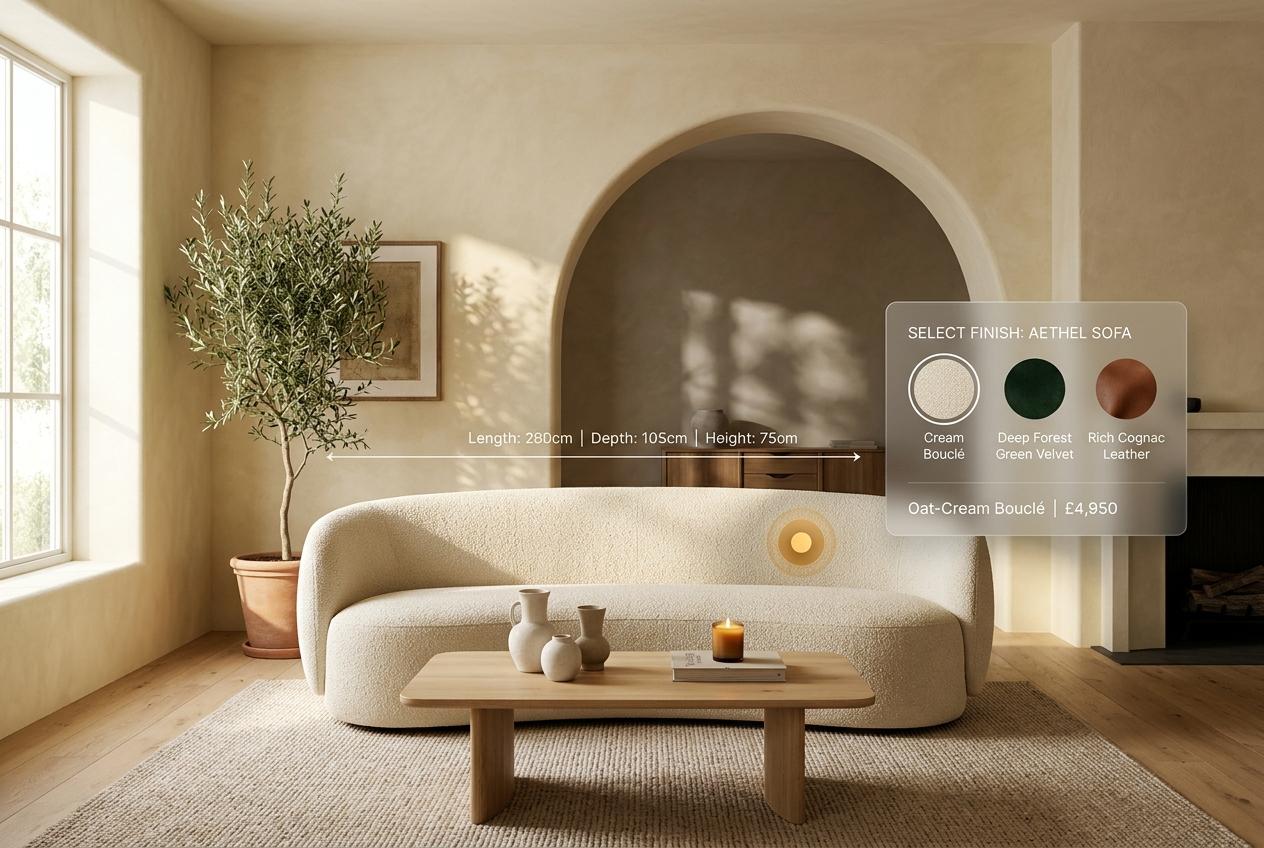
Furniture is experiential and emotional. A floating sofa cutout strips away scale, lighting, and texture. In 2026, leading brands have transitioned to lived-in architectural vignettes:
- Architectural Staging: Showcasing furniture in warm environments featuring lime-wash plaster walls, herringbone oak floors, and architectural arched doorways.
- Realistic Scale Anchors: Placing everyday scale cues—such as a resting coffee mug, an open art book, or an architectural floor lamp—so the customer's eye instinctively gauges height and depth.
- The 60/40 Ratio: Top stores use the first 60% of gallery assets for editorial lifestyle rooms, followed by 40% for hyper-detailed macro closeups showing stitch craft, cushion fill density, and joinery.
Trend 2: Interactive 2D Blueprint Schematics & Doorway Clearance Checkers
The number one driver of furniture cart abandonment is spatial anxiety. Listing dimensions as flat text in an accordion (e.g., "88"W x 38"D x 34"H") forces the customer to mentally calculate 3D geometry—and when confused, customers do not buy.
Worse, up to 12% of luxury sofa returns happen because the piece literally cannot fit through the customer's stairwell or hallway door.
The High-Converting Solution:
- Architectural 2D Line Schematics: Displaying clean, blueprint-style line drawings directly on the product detail page (PDP) that clearly illustrate seat depth, arm height, leg clearance, and diagonal depth.
- Interactive Doorway Clearance Checker: A micro-module where shoppers select their door type (e.g., standard 32" apartment door vs. 36" front door) and receive instant visual clearance confirmation: "✅ Guaranteed to fit through standard doorways (requires 31" minimum clearance with legs removed)."
Trend 3: The Swatch Sample Kit with Voucher Rebound
Just as luxury fragrance brands conquered blind-buy anxiety with perfume discovery sets, high-end furniture brands have turned fabric and finish swatch sampling into their primary customer acquisition engine.
Customers refuse to commit $2,500 to an upholstery piece without feeling the weight of the linen, testing the rub resistance of the velvet, and seeing the grain of the walnut in their home.
The Swatch Voucher Model:
- Low-Friction Sampling: Position a dedicated "Order Fabric Swatches" button directly below the primary Add to Cart button. Shoppers select 4 to 6 custom swatches for $10 with free priority shipping.
- The Enclosed Voucher Code: Inside the beautifully packaged swatch envelope (and via an automated email sequence), the customer receives a unique $50 store credit voucher valid for 30 days toward any furniture purchase.
- High Conversion Velocity: Brands utilizing this sampling funnel report that 38% of swatch purchasers convert into full-ticket furniture buyers within 21 days, virtually eliminating fabric color returns.
Trend 4: Dual-Lighting Visualizers (Daylight 5000K vs. Warm Evening 2700K)
Have you ever purchased a rich olive green or camel velvet sofa online, only for it to look dark mustard under your living room lamps?
Color metamerism—the optical phenomenon where fabric colors shift dramatically depending on the ambient light spectrum—causes over 20% of furniture color-discrepancy returns.
High-growth interior brands now feature an interactive lighting toggle directly above the product image carousel:
- Daylight Mode (5000K): Displays the furniture in crisp, bright midday sun coming through large windows.
- Warm Evening Ambient Mode (2700K): Simulates cozy 2700K living room incandescent lighting.
Giving shoppers control over ambient lighting simulation sets accurate expectations, builds immense trust, and protects operating margins from costly two-way freight returns.
Trend 5: "Shop the Room" Shoppable Lookbooks with Interactive Hotspot Pins
In luxury home decor, customers do not think in isolated product categories—they think in complete room aesthetics.
Rather than forcing shoppers to hunt across separate category pages for matching side tables, rugs, and ambient floor lamps, high-performing storefronts utilize interactive room lookbooks:
- Full-bleed editorial room scenes featuring subtle, pulsing hotspot pins.
- Clicking any pin opens a clean slide-out drawer displaying product specs, wood finishes, and real-time inventory status.
- An instant "Add Complete Room to Cart" button that bundles the entire aesthetic with a tiered order incentive (e.g., Save 15% when you furnish the living room).
This single merchandising UX pattern lifts average order value (AOV) from $950 to over **$2,600**.
Trend 6: Transparent Freight & White-Glove Logistics on the PDP
In standard e-commerce, shipping is a small flat fee calculated at the final payment step. In furniture, shipping involves 200 lb multi-box pallets, liftgate freight trucks, and delivery appointments.
Hiding delivery fees until the final step of checkout causes immediate cart abandonment. High-converting furniture PDPs present transparent logistics upfront:
| Delivery Tier | What It Includes | Customer Perception |
|---|---|---|
| Standard Freight (Free) | Curbside drop-off on pallet with liftgate service. | Expected standard threshold. |
| Room of Choice (+$79) | Two-person delivery team brings boxes into designated room. | High-value upgrade for apartment dwellers. |
| White-Glove Assembly (+$149) | Full in-room assembly, placement, and complete packaging debris removal. | Ultimate luxury experience; 32% opt-in on $2k+ orders. |
Pairing these tiers with an accurate dispatch counter (e.g., "Quick-Ship: Leaves warehouse in 48 hours" vs. "Made to Order: Handcrafted in 4–6 weeks") eliminates post-purchase customer support tickets.
Trend 7: Tactile Material Transparency & Durability Metrics (Martindale & FSC)
Today's interior design buyers are educated and conscious. They want to know how a piece will hold up to pets, wine spills, and kids before investing thousands of dollars.
High-growth brands prominently display structured durability indicators:
- Martindale Rub Count / Wyzenbeek Double Rubs: Clear badges verifying commercial-grade durability (e.g., 50,000+ double rubs — Pet & Family Friendly).
- FSC-Certified Solid Timber: Verification of sustainable, kiln-dried solid hardwood framing rather than particleboard.
- OEKO-TEX & CertiPUR-US: Non-toxic, low-VOC certification callouts for foam cushions and natural dyes.
The Operational Backbone: Managing Complex Furniture Catalogs
While beautiful storefront UX drives conversions, managing a furniture catalog behind the scenes is notoriously complex:
- A single sectional sofa can spawn 180+ variant combinations across fabric grades, wood leg stains, and chaise orientations.
- Seasonal factory shutdowns require updating lead-time notices (e.g., from 3 weeks to 8 weeks) across 2,500 SKUs simultaneously.
- Multi-box shipping requires mapping accurate dimensional freight classes to avoid crippling freight carrier surcharges.
As we detailed in our guide on Shopify Bulk Editor vs. CSV Import, traditional spreadsheets break when handling complex variant matrices. High-growth furniture brands increasingly rely on NorthStar Bulk Product Editor and its Variant & SKU management tools to automate lead-time notices, map multi-box shipping tags, and update pricing across complex fabric tiers without spreadsheet errors.
Frequently Asked Questions
What is the average e-commerce conversion rate for luxury furniture stores?
High-ticket furniture stores ($1,500+ AOV) typically see conversion rates between 0.6% and 1.2% due to intense customer spatial doubt, fabric hesitation, and shipping friction. Brands implementing specialized Scent/Tactile UX—such as 2D dimension blueprints, fabric swatch vouchers, and upfront freight calculators—routinely lift conversion rates past 2.1%.
How do doorway clearance calculators reduce furniture return rates?
Up to 12% of large furniture returns occur because an item cannot physically pass through the customer's front door, elevator, or stairwell hallway. Interactive doorway clearance calculators on the product detail page allow shoppers to input their entry dimensions and confirm fit before ordering, completely preventing logistics delivery failures.
What is the Swatch Voucher Model in home decor e-commerce?
The Swatch Voucher Model allows shoppers to order a physical material kit (e.g., 4–6 fabric or wood swatches for $10) paired with an enclosed $50 store credit coupon toward their full furniture order. This eliminates tactile uncertainty and drives an average 38% conversion rate from sample buyers into multi-thousand-dollar furniture purchases.
Why is dual-lighting preview important on furniture product pages?
Upholstery fabrics (especially velvets, bouclés, and top-grain leathers) shift color dramatically between 5000K natural daylight and 2700K warm interior evening lighting. Offering an interactive lighting toggle on the product gallery sets realistic color expectations and reduces color-discrepancy returns by over 20%.
How do furniture brands manage thousands of variant combinations without spreadsheet errors?
A single sofa can generate 180+ variant combinations (fabric grade × wood stain × configuration). High-growth stores use rule-based catalog tools like NorthStar Bulk Product Editor to automate lead-time updates, multi-box freight tags, and pricing formulas without the risk of CSV spreadsheet corruption.
Ready to elevate your home decor brand and master high-ticket conversion? Discover how NorthStar Commerce provides the automation tools, catalog infrastructure, and e-commerce engineering needed to scale luxury home living brands with confidence.