Selling a $1,200 high-performance coilover suspension kit or a $450 remanufactured alternator online is one of the most operationally demanding challenges in modern e-commerce.
Unlike fashion or lifestyle retail, automotive aftermarket customers are not browsing for visual aesthetics alone. They are solving an urgent mechanical requirement under strict compatibility constraints: "Will this exhaust manifold bolt up to my 2021 Ford F-150 3.5L EcoBoost without throwing an engine check light? Does this brake kit fit my 18-inch wheels, or will the calipers hit the spokes?"
If a customer orders the wrong part, the fallout is devastating: their vehicle sits disassembled on jack stands in a garage or repair bay, the merchant pays $80+ in round-trip heavy freight, and the buyer's trust is permanently shattered. In fact, industry data shows that over 62% of auto parts returns are caused directly by fitment confusion.
Just as we analyzed in our design breakdowns for Luxury Jewelry & Watch E-Commerce Trends and Furniture E-Commerce Spatial UX, high-growth brands succeed by replacing hesitation with empirical certainty.
Here are the 7 automotive aftermarket e-commerce design trends defining high-growth brands in 2026 and 2027.
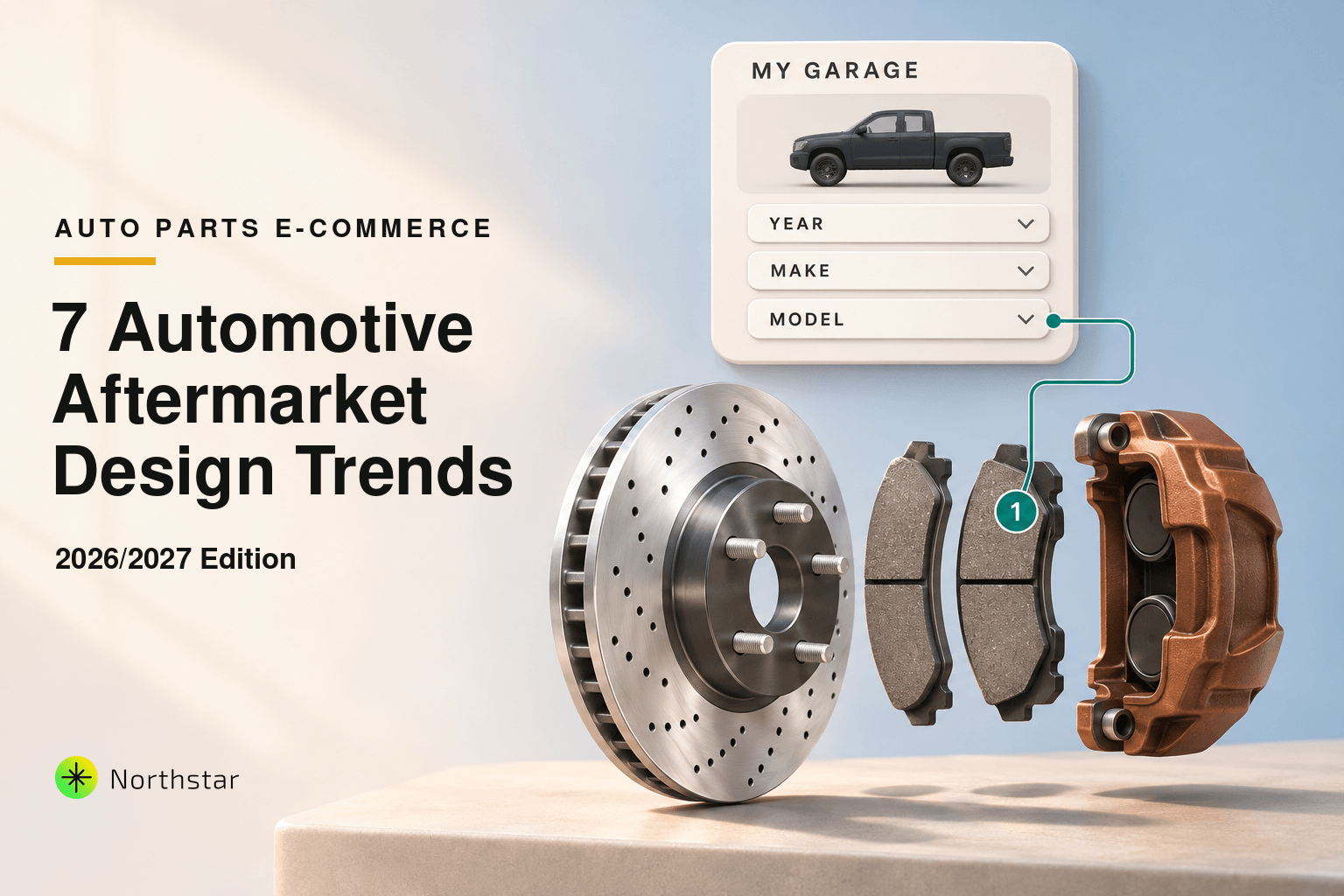
Trend 1: Persistent Sticky "My Garage" YMM Selectors
The traditional auto parts storefront forced buyers to manually re-select their vehicle on every collection page or squint at endless compatibility tables containing hundreds of engine trims.
In 2026/2027, modern high-growth platforms treat the customer's vehicle as a first-class global session attribute:
- Persistent Header Garage Widget: Shoppers enter their Year, Make, Model, and Engine/Trim (or simply enter their 17-character VIN or license plate number). The selected vehicle anchors to the top navigation bar across their entire session.
- Automatic Catalog Filtering: Once "2024 Toyota Tacoma 2.4L Turbo" is selected, all collection grids, search auto-completes, and banner promotions dynamically filter out incompatible parts.
- Multi-Vehicle Profiles: Enthusiasts frequently own multiple project cars or daily drivers. Modern stores allow customers to save multiple vehicles to their digital garage with a 1-click toggle.
Trend 2: Interactive Exploded Parts Schematics & Assembly Hotspots
When DIY enthusiasts or professional mechanics need replacement hardware—such as a specific throttle body gasket, bracket bolt, or ABS wheel speed sensor—they do not know the generic marketing product title. They know where the part sits inside the mechanical assembly.
Top brands have transitioned from unstyled text lists to Interactive Exploded 2D/3D Schematics:
- Clickable Hotspot Overlays: Detailed technical assembly diagrams feature clickable numbered pins. Hovering over Pin #14 highlights the exact water pump o-ring gasket.
- Real-Time Inventory Status in Hover Card: Clicking the pin slides open a micro-drawer showing the exact replacement SKU, brand options (OEM Genuine vs. Performance Aftermarket), stock availability, and an instant "Add to Cart" CTA.
- Complete Assembly Bundling: An "Add All Gaskets & Bolts for This Job" bundle button allows mechanics to purchase the entire repair kit in one click, lifting Average Order Value (AOV) by over 30%.
Trend 3: The "100% Guaranteed Fitment" Trust Engine & VIN Verification
Nothing accelerates checkout conversion like removing the financial downside of a mistake.
Leading storefronts place a prominent Fitment Verification Engine directly adjacent to the primary "Add to Cart" button:
- Dynamic Fitment Status Pill: If the vehicle is set in "My Garage", the PDP displays a bright green checkmark: "✓ Guaranteed Fit: 2022 Chevrolet Silverado 1500 (V8 5.3L)".
- The Misfit Warning Modal: If an unverified user tries to add a vehicle-specific part to cart, a gentle modal appears: "Confirm your vehicle before purchasing to ensure 100% fitment and free return protection."
- 100% Pre-Paid Return Guarantee: If the merchant's fitment engine verifies a part and it fails to bolt on correctly, the brand guarantees free return freight shipping with zero restocking fees.
Trend 4: Core Charge Transparency & Pre-Paid Return Mechanics
In automotive repair, many high-ticket items (brake calipers, starters, alternators, steering racks, turbochargers) involve a core charge—a mandatory deposit to encourage customers to send back their worn factory component for rebuilding.
Generic e-commerce stores fail by hiding core charges until the final checkout screen, triggering high cart abandonment. High-converting brands engineer Core Charge Transparency:
- Dual-Price PDP Breakdown: The PDP clearly displays: "$289.00 Part Price + $75.00 Refundable Core Deposit (Total: $364.00)".
- Interactive Core Return Explanation: An expandable drawer explains the 3-step return process: *"1. Receive your new part in our heavy-duty box. 2. Place your old part inside with the enclosed pre-paid return label. 3. Drop it off at FedEx and receive your $75 refund within 48 hours of delivery."*
- Instant Digital Core Tracking: Customers can track their core inspection status directly inside their customer account portal.
Trend 5: Multi-Warehouse Split Freight & LTL Pallet Delivery Calculators
Automotive parts vary from a 2-ounce micro-sensor to a 250-pound steel off-road bumper or crated crate motor requiring Less-Than-Truckload (LTL) liftgate delivery.
Surprising customers with unexpected freight charges at checkout kills sales. Progressive 2026 brands implement Upfront Logistics Transparency:
- Real-Time ZIP Code Freight Quoter: Directly on the PDP, customers enter their postal code to calculate exact ground shipping or LTL freight costs before adding the product to cart.
- Liftgate & Commercial Delivery Selectors: For heavy pallet freight, customers can toggle between residential delivery with liftgate service or commercial shop address delivery with a loading dock (discounting shipping by $50–$80).
- Split-Shipment Routing Visibility: If an order contains parts originating from multiple regional warehouses (e.g., Dallas and Columbus), the cart clearly indicates delivery dates per package rather than showing confusing unified transit estimates.
Trend 6: Skill Level Indicators, Tool Lists & Video Installation Guides
Even when a customer is confident a part fits, they frequently abandon because they fear the installation will be too difficult: "Can I install this cold air intake in my driveway in an afternoon, or do I need a lift and specialty flare nut wrenches?"
High-growth storefronts convert hesitant DIYers by demystifying installation:
- Installation Difficulty Badge: Clear rating pills (e.g., *"Difficulty: 2 of 5 • Estimated Time: 45 Minutes • Skill: Beginner DIY"*).
- Required Tool Checklist: Listing exact socket sizes (e.g., 10mm, 12mm deep socket, T25 Torx), giving customers confidence they already own the tools required.
- Step-by-Step Video Integration: Embedding short 2-minute time-lapse installation videos directly into the media carousel.
- "Professional Installation Option": Offering a 1-click checkout add-on connecting the customer with a certified local mobile mechanic or network shop.
Trend 7: 360° Macro Finish Spinners & Audio Soundwave Players
Performance enthusiasts take immense pride in the visual and acoustic characteristics of their vehicles.
In 2026, leading performance exhaust, turbo, and wheel brands leverage sensory media:
- High-Fidelity Audio Sound Clips: For cat-back exhaust systems and intake kits, the PDP embeds an audio player comparing *"Cold Start vs. Idle vs. Wide-Open Throttle"* alongside a stock exhaust sound comparison.
- 360° Finish Spinners: For forged alloy wheels and titanium hardware, interactive 3D spinners showcase concavity, offset, and micro-machining bevels under multiple lighting angles.
Storefront UX Benchmark: Traditional Auto Parts vs. 2026/2027 Leader
| Storefront Dimension | Traditional Auto Parts Retailer | Modern 2026/2027 High-Growth Storefront | Conversion Impact |
|---|---|---|---|
| Fitment Validation | Manual dropdown selection on every collection; easy to pick wrong trim. | Persistent sticky "My Garage" session filter + VIN auto-decoder + Fitment Guarantee badge. | -68% Fitment Return Rate |
| Hardware Navigation | Cluttered text lists with hundreds of cryptic OEM part numbers. | Interactive 2D exploded schematics with clickable part hotspots and bundle buttons. | +32% Hardware AOV Lift |
| Core Charge UX | Hidden deposit fees surfaced unexpectedly at final checkout step. | Transparent dual pricing + prepaid return label guide and automated deposit refunds. | -26% Checkout Drop-Off |
| Logistics & Delivery | Generic shipping lines; sudden $150 pallet freight fees. | Real-time ZIP freight quoter, liftgate toggles, and multi-warehouse split visibility. | +19% High-Weight Cart Conversions |
The Catalog Architecture Behind 100,000+ Automotive SKUs
The complexity of automotive commerce doesn't end at the storefront interface. Behind the scenes, auto parts merchants must maintain massive, hyper-complex relational databases:
- Industry Standards (ACES & PIES): Product data must comply with the Auto Care Association's ACES (fitment/applications) and PIES (product attributes, dimensions, and weights) protocols.
- Interchange Part Numbers & Cross-References: A single aftermarket brake pad might replace 14 different OEM part numbers across Honda, Acura, and Nissan models. Tracking these interchange numbers in product metafields is essential for internal search and Google Shopping indexing. For strategies on standardizing barcodes and universal identifiers, see our guide on Bulk Updating Barcodes and GTINs in Shopify.
- Frequent Supplier Feed Price Changes: Raw material surcharges (aluminum, steel) and supplier cost updates occur weekly across 50,000+ SKUs.
Why Auto Parts Brands Outgrow Spreadsheet CSVs
In automotive e-commerce, exporting and re-importing huge CSV spreadsheets is a recipe for disaster. Microsoft Excel notoriously truncates leading zeros on OEM part numbers (e.g., 04465-33450 becomes 446533450), permanently corrupting search indexes. Furthermore, Shopify's native CSV import fails when processing catalogs over 20,000 variants.
High-growth aftermarket merchants scale with NorthStar Bulk Product Editor. With NorthStar, catalog teams can filter products by vendor, collection, or custom metafield, execute bulk price markup formulas, update fitment tags, and preview every single change in real time with 1-click rollback peace of mind. Learn more in our breakdown of Shopify Bulk Editor vs. CSV Import.
Conclusion: Engineering Unshakable Buyer Confidence
Automotive aftermarket customers are passionate, pragmatic, and detail-oriented. They do not buy parts on impulse; they buy when your storefront eliminates every trace of doubt regarding compatibility, installation difficulty, and delivery logistics.
By investing in persistent YMM selectors, interactive exploded schematics, guaranteed fitment badges, and core charge transparency, your brand builds an insurmountable competitive moat against outdated catalog competitors.